

Who’s Who in Lipoedema Care
Who is Who? (Understanding Your Care Team)
Understanding the language and professionals involved in lipoedema care can feel overwhelming. This page is designed to simplify the terminology, clarify roles, and help you confidently navigate your care options.

-
A university-qualified clinician trained in assessment, education, wound care and clinical monitoring. In the context of lipoedema care, an RN supports conservative management, pre and post operative preparation and recovery education.
An RN is often the link between you and other Healthcare Professionals.
-
Your primary care doctor. A GP can coordinate investigations, manage chronic disease & mental health care plans, order blood tests, prescribe and monitor medications and imaging, and refer you to appropriate specialists. In Australia, GPs complete medical school plus specialist GP training.
You can verify any registered medical practitioner via the AHPRA public register: https://www.ahpra.gov.au/Registration/Registers-of-Practitioners.aspx
-
A surgeon is a medical specialist trained to perform surgical procedures. In Australia, surgeons complete medical school followed by several years of hospital-based surgical training through an accredited Royal College program.
Not all surgeons are plastic surgeons. The title “surgeon” alone does not indicate specialist plastic surgery training. The title ‘Surgeon’ is protected in Australia.
What Does “Protected Title” Mean?
In Australia, certain professional titles are legally protected under national health regulation laws. This means a practitioner can only use titles such as “Medical Practitioner” or “Specialist Plastic Surgeon” if they are formally registered with AHPRA in that specific category. It is unlawful for someone to present themselves as a specialist or surgeon without the recognised training and registration to support that title.
-
A Plastic Surgeon is a medical specialist who has completed extensive additional training specifically in reconstructive and cosmetic surgery. In Australia, a Plastic Surgeon completes:
5–6 years medical degree
Internship and residency (1–2+ years)
Entry into Royal Australasian College of Surgeons (RACS) training
Approximately 5 additional years of accredited specialist training in Plastic & Reconstructive Surgery
This means a Plastic Surgeon has several additional years of highly specialised training beyond general surgical training, specifically in soft tissue handling, reconstruction, microsurgery and complex body contouring procedures.
You can verify if your surgeon is a Specialist Plastic Surgeon via: AHPRA or Australian Society of Plastic Surgeons (ASPS). Membership with ASPS indicates completion of accredited specialist plastic surgery training.
-
A Vascular Surgeon is a specialist medical doctor trained in the diagnosis and surgical management of diseases affecting the arteries and veins. They manage complex conditions such as peripheral arterial disease, aneurysms, deep vein thrombosis, chronic venous insufficiency and advanced vein disorders, and are qualified to perform hospital-based vascular surgery when required.
Vascular Surgeons complete medical school followed by specialist surgical training through the Royal Australasian College of Surgeons (RACS) and hold Specialist Registration in Vascular Surgery with AHPRA.
-
A Phlebologist is a medical doctor who focuses specifically on vein health and venous disease. They commonly assess and treat conditions such as varicose veins, spider veins and venous insufficiency, often using minimally invasive, clinic-based procedures such as sclerotherapy or endovenous laser treatments.
Unlike a Vascular Surgeon, a Phlebologist is not trained in major arterial surgery and does not perform complex hospital-based vascular operations. Their scope is generally limited to venous disease management.
A Phelbologist is often skilled in using Ultrasound to diagnose venous disease.
In relation to Lipoedema a Phlebologist can drain post surgical seromas (fluid collections), map out leg veins to check for competency and treat legs veins pre and post surgery.
-
A Remedial Massage Therapist is a qualified allied health practitioner trained to assess and treat muscles, tendons, ligaments, and connective tissues to support pain relief, mobility, and overall physical function. Treatment techniques may include manual lymphatic drainage, deep tissue massage, trigger point therapy, myofascial release, and other therapeutic approaches tailored to the individual’s needs.
In Australia, many remedial massage therapists are members of professional associations such as the Massage & Myotherapy Australia or the Australian Traditional-Medicine Society, which support professional standards, continuing education, and practitioner accreditation.
Patients may be eligible for private health insurance rebates when seeing a remedial massage therapist who is registered with an approved association and holds the appropriate provider number. In some cases, services may also be accessed through a Medicare-funded Chronic Disease Management Plan (CDM) when referred by a GP, although the level of rebate and eligibility will depend on individual circumstances and the practitioner’s qualifications.
-
The Australasian Lymphology Association (ALA) is the peak professional body representing clinicians who work in lymphoedema and lymphatic disorders across Australia and New Zealand.
Being ALA accredited means the practitioner:
Has completed recognised lymphoedema education and clinical training
Meets ongoing professional development requirements
Adheres to professional standards in lymphatic assessment and management
Is committed to evidence-informed practice in lymphatic care
This accreditation provides reassurance that your clinician has formal training in lymphatic disorders rather than general massage-only qualifications.
You can learn more about the ALA here: https://www.lymphoedema.org.au
-
A university-trained movement clinician who supports mobility, strength and functional rehabilitation. They may provide exercise prescription, compression guidance, Manual Lymphatic Drainage techniques and structured rehabilitation programs to support circulation, reduce swelling and improve functional movement.
-
An Occupational Therapist (OT) is a university-trained clinician who supports individuals to maintain independence in daily life while managing physical health conditions. Some OTs undertake additional training in lymphoedema management and focus specifically on lymphatic care, including breast cancer–related lymphoedema, post-surgical swelling and chronic oedema conditions.
Who’s Who in Lipoedema Care
What Is What? (Understanding Common Terms & Therapies)
Understanding the language and professionals involved in lipoedema care can feel overwhelming. This page is designed to simplify the terminology, clarify roles, and help you confidently navigate your care options.
-
TEO refers to Therapeutic Electrostatic Oscillation, a non-invasive, gentle, and deep-acting therapy device. It is used to treat tissues in cases of pain, edema, and to accelerate healing. It works by creating an electrostatic field between the device's applicator (or the therapist's hands) and the patient’s tissue.
This produces a gentle, pulsating, kneading effect known as electrostatic oscillation which penetrates up to 8 cm into the tissue, making it effective for treating skin, connective tissue, fat, muscle, blood, and lymph vessels.
For individuals living with lipoedema, the ability to influence deeper tissue layers makes TEO particularly valuable both before and after surgery. Pre-operatively, it can assist in preparing tissues by encouraging lymphatic movement and improving local circulation. Post-operatively, it can support the management of swelling, help soften fibrotic tissue, and assist the body’s natural lymphatic drainage as healing progresses.
Because TEO works beyond the superficial tissue layers, it provides a level of therapeutic stimulation that is difficult to achieve with manual techniques alone. Incorporating this technology allows us to offer a more advanced and comprehensive approach to tissue care for patients with lipoedema.
-
LED therapy is a gentle, non-invasive light treatment often used to support healing after surgery. Specific red and near-infrared light wavelengths are selected to help encourage healthy circulation and support the body’s natural repair processes. When used appropriately, LED therapy may assist in calming inflammation and helping bruising settle more efficiently during recovery.
It’s important to understand that not all LED devices are created equal. Clinical-grade systems used in medical settings are very different from at-home or beauty-based devices, with differences in power, wavelength precision and treatment depth. The quality of the device — and how it is used — plays an important role in achieving safe and effective outcomes.
-
SPIC devices designed for clinical & at home use to assist lymphatic and venous return. Often useful in managing symptoms of lymphoedema, lipoedema, chronic venous insufficiency, venous ulcers and pre-and post orthopaedic surgical swelling. Intermittent pneumatic compression mimics the body’s manual lymphatic drainage.
Always seek advice from an accredited practitioner before purchasing as there are some medical indications where SPIC is not recommended.
We can assist with the rental or purchase of a SPIC device.
-
Designed primarily for athletic recovery; pressure profiles and clinical intent differ from medical-grade lymphatic devices.
Although they may look similar to a SPIC pump, the programming, pressure gradients and therapeutic intent are different — which is why individual assessment is important before investing in a device.
You can feel a difference between a SPIC and SPORT pump, they are not equal.
-
An ABPI is a simple, non-invasive screening test used to assess arterial (the blood in your arteries) circulation in the legs. It compares the blood pressure in your ankle with the blood pressure in your arm to determine how well blood is flowing to your lower limbs.
This test is sometimes preformed before commencing compression therapy, particularly for individuals with diabetes, a history of smoking, cardiovascular disease, leg pain when walking, or wounds that are slow to heal. Identifying reduced arterial flow ensures that compression garments or pumps are prescribed safely and appropriately.
-
Manual Lymphatic Drainage (MLD) is a specialised, gentle technique designed to support lymphatic flow and manage swelling. There are several internationally recognised, medical-focused schools of MLD training, including Vodder, Földi, Casley-Smith and Leduc. While each method has slight variations in sequencing and hand technique, they all share core principles: light pressure, precise directional strokes, and an understanding of lymphatic anatomy to support therapeutic fluid movement in conditions such as lymphoedema and lipoedema.
These approaches differ significantly from what is often marketed as “Brazilian Lymphatic Drainage.” Brazilian-style treatments are typically more vigorous, faster-paced and cosmetically focused, aiming to create temporary contouring or visible fluid shifts. Often incorporating wooden tools.
Medical MLD, by contrast, is slower, more anatomically specific, and clinically guided — prioritising tissue health, skin integrity and long-term lymphatic support rather than immediate aesthetic change. Wooden tools are not used as they often create pain and increase inflammation.
-
Low Level Laser Therapy is a gentle, non-invasive light treatment used to support healing and tissue recovery. It works by delivering specific wavelengths of light into the skin and underlying soft tissue, where the light energy is absorbed by the cells. This energy may help support natural cell repair processes, calm inflammation and encourage healthy tissue regeneration.
Unlike some other therapies, LLLT does not produce heat, sound or vibration — most people feel little to nothing during treatment. The laser applicator is typically placed directly onto the skin over the area being treated, such as surgical sites, areas of swelling, or nearby lymph node regions. It is used as part of a broader care plan to support safe and steady recovery.
-
In Australia, many medical devices are required to be included on the Australian Register of Therapeutic Goods (ARTG) before they can be legally supplied for therapeutic use. An ARTG listing indicates that the device sponsor has met regulatory requirements set by the Therapeutic Goods Administration (TGA) regarding safety, quality and intended use.
Patients are encouraged to ask their practitioner whether a device is listed on the ARTG and to understand its intended clinical purpose. Being informed about the regulatory status of devices used in your care supports transparency and helps you make confident healthcare decisions.

Understanding How to Apply and Remove your Garments Safely
Donning & Doffing Compression Garments
When discussing compression garments, you may hear the terms donning and doffing.
These are clinical terms used to describe:
Donning → Putting compression garments on
Doffing → Removing compression garments
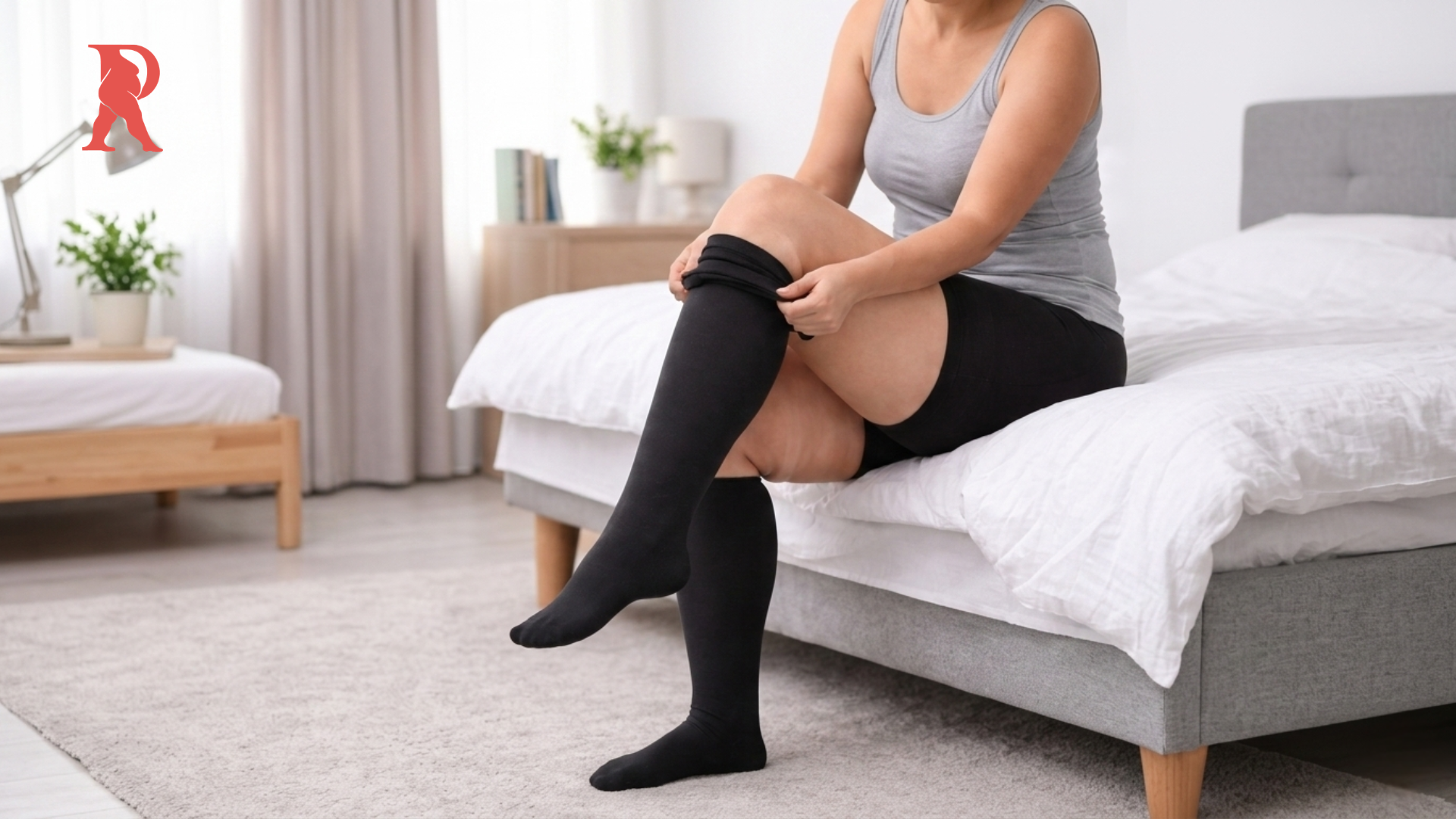
Because medical compression is firmer than everyday clothing, correct technique is important for comfort, effectiveness and garment longevity. Improper donning can reduce effectiveness and shorten the lifespan of the garment.
Compression garments are designed to apply graduated pressure, meaning:
The garment is firmest at the ankle
Pressure gradually decreases toward the thigh
This gradient assists circulation and lymphatic support.
Because of this structure, garments can feel tight when first applied.
Correct donning technique helps:
Ensure proper pressure distribution
Prevent overstretching the fabric
Protect skin integrity
Avoid unnecessary strain on the garment
Doffing refers to safely removing your compression garment.
It is important not to:
Tug garments off quickly
Roll them down forcefully
Pull from the top edge aggressively
Correct Doffing helps:
Maintain fabric elasticity
Protect delicate skin
Prevent tearing
Reduce discomfort